Drilling Water Wells in Sandy Soil: Collapse Control Guide
Detailed sandy-soil borehole drilling guide covering collapse prevention, mud circulation, casing, screens and LIYO compact water well drilling rig selection.
Understand the Ground Before Choosing the Machine
Loose sand has little cohesion and can flow into an unsupported borehole. Fine sand may stay suspended in drilling fluid, while coarse sand settles quickly and requires higher carrying capacity. Saturated sand is especially sensitive to pressure changes and long pauses.
Main Drilling Risks
The principal risks are wall collapse, sand bridges, buried drill strings, lost tools, stuck casing and continued sand production after the well is completed. An oversized open hole without adequate support may collapse faster than the operator can clean it.
Recommended Starting Method
Mud rotary drilling with stable circulation is commonly used. Advance in controlled intervals, maintain a full borehole and install temporary or permanent casing when the formation cannot stand open. Avoid aggressive swabbing that creates pressure fluctuations.
Match the Bit and Cleaning System to the Formation
Drill-Bit Selection
Use a drag, wing or alloy soil bit sized for the planned casing and gravel pack. The bit must open the hole without excessive disturbance. Large jumps in reaming diameter can destabilize loose sand, so staged reaming may be safer.
Mud or Air Cleaning
Fluid must build a thin supporting filter cake while still returning sand to the pit. Maintain fluid level during rod changes. If returns decrease, check leakage and wall loss before continuing; if sand settles in the annulus, circulate until returns are clean.
Casing, Screen and Pump Planning
Screen slot, gravel size and casing diameter are part of the drilling decision. The borehole needs annular space for a uniform gravel pack. Poorly selected screen and gravel can cause long-term sand pumping even when the drilling machine performed correctly.
Practical Construction Sequence
Use this sequence as a planning checklist. The operator must still adjust feed, speed, fluid or air and casing to actual returns and local well-construction requirements.
Step 1
Collect grain-size information and identify the expected water-bearing sand interval.
Step 2
Set surface casing and establish stable mud circulation.
Step 3
Drill short intervals while keeping the hole full during every rod change.
Step 4
Condition and clean the hole before running screen and casing.
Step 5
Place gravel pack gradually, seal the upper annulus and develop the well until sand content falls.
What Changes With Geology?
| Decision | What to Check | Why It Matters |
|---|---|---|
| Depth and diameter | Finished depth, bit diameter, casing OD and pump OD | Larger holes require more torque, cleaning capacity and practical depth margin |
| Formation | Layer sequence, hardness, fractures, abrasiveness and stability | Determines drilling method, bit, casing and expected penetration |
| Cuttings removal | Mud-pump flow and pits, or compressor pressure and air volume | Cuttings left in the annulus cause sticking, wear and false depth limits |
| Rig capacity | Machine mass, torque, feed, pullback, rods and mast | A catalog depth cannot compensate for an under-sized working system |
| Operator control | Logs, returns, penetration, torque and cleaning cycles | Early formation recognition prevents tool damage and borehole loss |
Responsible Compact-Rig Limitation
In loose sand, stability and well completion usually control success more than raw drilling power. A compact rig can be economical only when the mud, casing and screen program is prepared in advance.
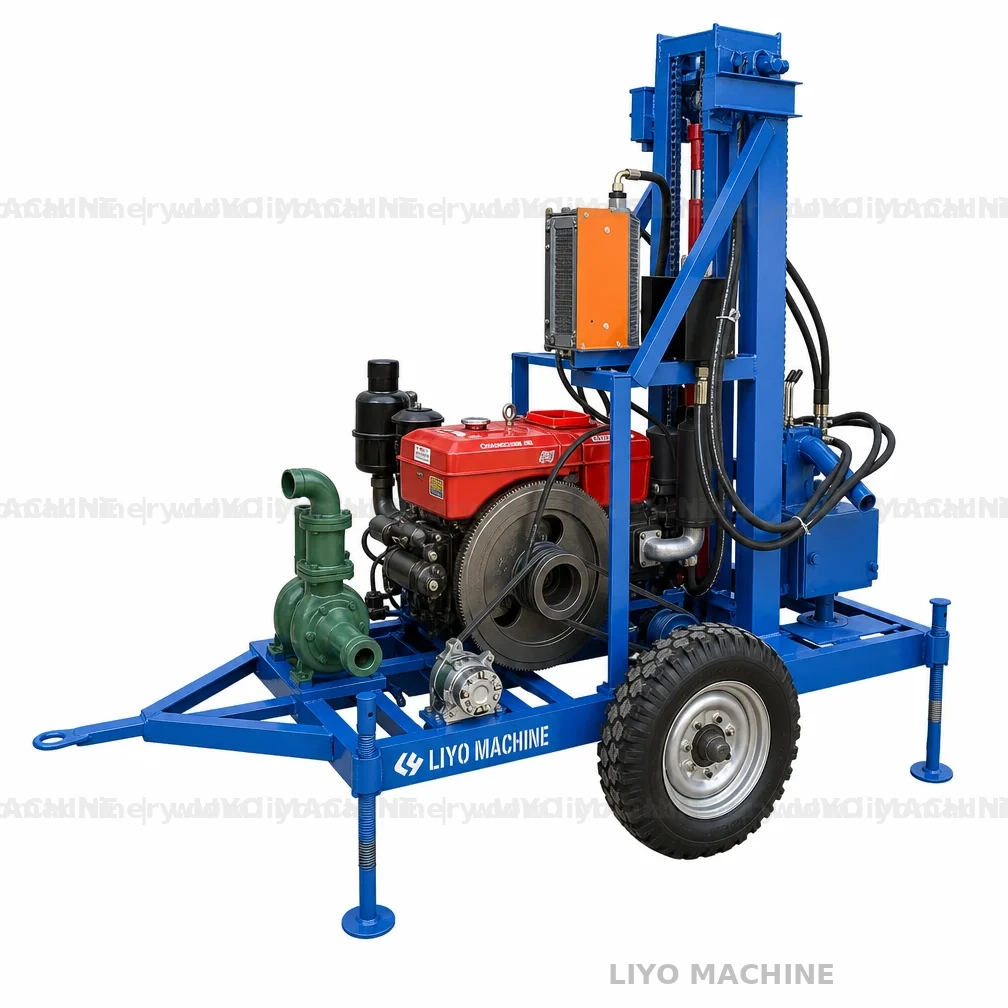
LIYO compact rigs are built mainly for portability, easy operation and lower investment. A responsible recommendation uses real geology and borehole dimensions instead of promising maximum rated depth in every rock.
LIYO Models to Compare
Final configuration depends on depth, diameter, geology, drilling method, terrain and transport.
Continue the Drilling Selection Process
Questions From Water Well Drilling Buyers
What information is needed before selecting the rig?
Provide the application, target depth, required borehole diameter, casing and pump size, geological layers, terrain, drilling method and whether an air compressor is already available.
Which drilling method is recommended for this formation?
Mud rotary drilling with stable circulation is commonly used. Advance in controlled intervals, maintain a full borehole and install temporary or permanent casing when the formation cannot stand open. Avoid aggressive swabbing that creates pressure fluctuations.
Which drill bit should be used?
Use a drag, wing or alloy soil bit sized for the planned casing and gravel pack. The bit must open the hole without excessive disturbance. Large jumps in reaming diameter can destabilize loose sand, so staged reaming may be safer.
Can a compact rig guarantee maximum rated depth?
No. In loose sand, stability and well completion usually control success more than raw drilling power. A compact rig can be economical only when the mud, casing and screen program is prepared in advance.
How should the finished well diameter be planned?
Use the rule: borehole diameter must exceed casing outside diameter, and casing inside diameter must exceed submersible pump outside diameter. Also allow space for gravel pack and installation tolerance where required.
Is Drilling Water Wells in Sandy Soil the only geology expected in the hole?
Do not assume so. Ask for nearby well logs and monitor returns, torque and penetration because several layers commonly occur in one borehole.
Send LIYO Your Real Geological Conditions
Tell us the application, depth, borehole diameter, casing and pump size, terrain, soil or rock layers, destination and compressor specifications if available.