Loess and Loose Formation Water Well Drilling Process
Choose drilling tools, mud circulation, casing and LIYO equipment for loess and loose formations while reducing collapse, washout and buried-tool risk.
Understand the Ground Before Choosing the Machine
Loess and other loose silty formations may appear firm when dry but lose strength rapidly after water enters. Natural pores and vertical joints can accept drilling fluid, and unsupported walls may ravel or collapse during pauses.
Main Drilling Risks
Typical failures are washout, lost circulation, sudden enlargement, buried rods and inaccurate finished diameter. Fast drilling without checking returns may create a large unstable cavity that later prevents proper gravel packing or sealing.
Recommended Starting Method
Use controlled mud rotary drilling and minimize open-hole exposure time. Establish surface casing early, keep the annulus full and drill with lower hydraulic disturbance than would be used in competent soil. Stage the hole if a large final diameter is required.
Match the Bit and Cleaning System to the Formation
Drill-Bit Selection
Open soil bits or alloy drag bits are generally considered. Select cutting geometry that makes steady cuttings without over-agitating the wall. A large aggressive bit can increase washout, so diameter planning matters as much as penetration speed.
Mud or Air Cleaning
Use enough viscosity and flow for support and transport, but avoid excessive pump pressure against a fragile wall. Monitor pit level continuously. Losses should trigger an assessment of fractures, pores and possible bridging material rather than simply increasing pump output.
Casing, Screen and Pump Planning
Run casing promptly through weak intervals. Centralize the casing and place annular materials carefully so they do not bridge above a washed-out zone. The final seal should protect the aquifer from surface contamination.
Practical Construction Sequence
Use this sequence as a planning checklist. The operator must still adjust feed, speed, fluid or air and casing to actual returns and local well-construction requirements.
Step 1
Identify whether the loess is dry, saturated, jointed or interbedded with sand.
Step 2
Install conductor casing and prepare reserve drilling fluid.
Step 3
Drill with controlled circulation and record any loss of returns.
Step 4
Clean gently and confirm the hole remains open before casing.
Step 5
Complete casing, screen, gravel and sanitary seal without long delays.
What Changes With Geology?
| Decision | What to Check | Why It Matters |
|---|---|---|
| Depth and diameter | Finished depth, bit diameter, casing OD and pump OD | Larger holes require more torque, cleaning capacity and practical depth margin |
| Formation | Layer sequence, hardness, fractures, abrasiveness and stability | Determines drilling method, bit, casing and expected penetration |
| Cuttings removal | Mud-pump flow and pits, or compressor pressure and air volume | Cuttings left in the annulus cause sticking, wear and false depth limits |
| Rig capacity | Machine mass, torque, feed, pullback, rods and mast | A catalog depth cannot compensate for an under-sized working system |
| Operator control | Logs, returns, penetration, torque and cleaning cycles | Early formation recognition prevents tool damage and borehole loss |
Responsible Compact-Rig Limitation
Loose formation is not a reason to select the heaviest machine automatically. The critical factors are wall support, circulation control and timely casing; compact equipment still needs a disciplined construction plan.
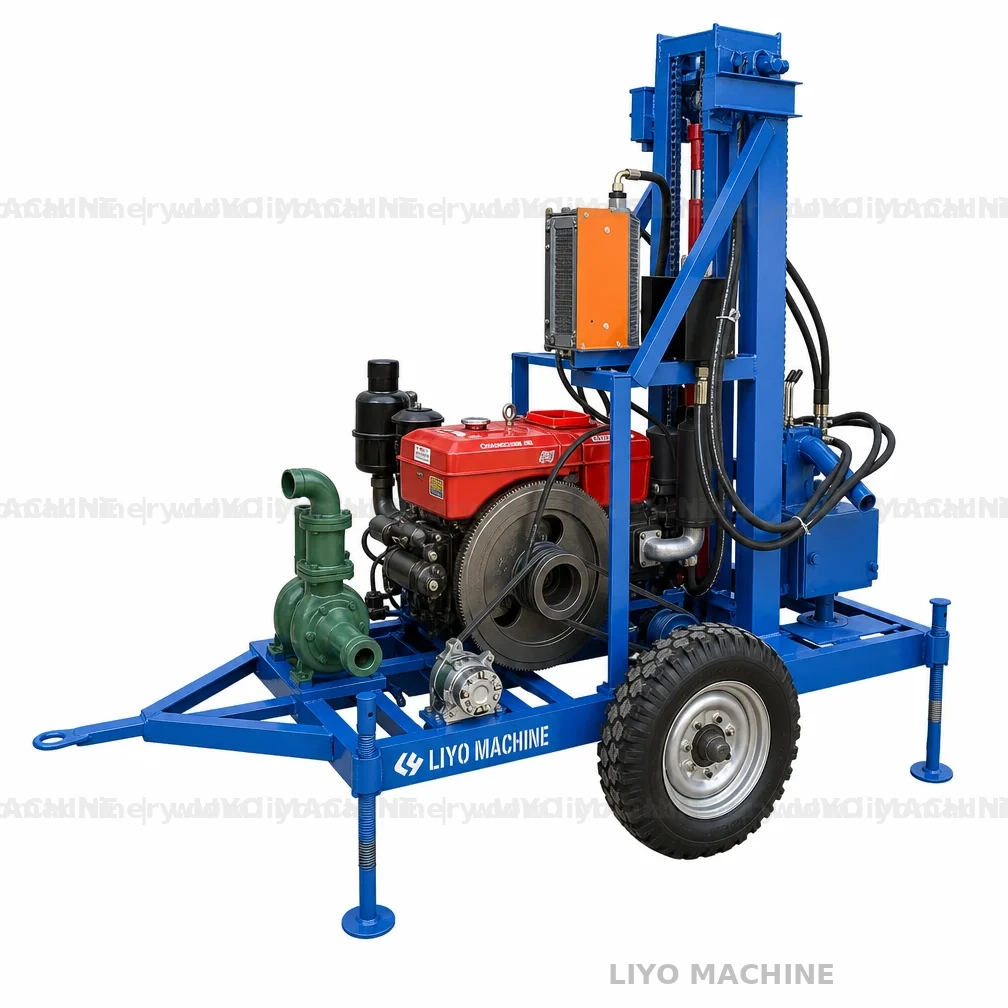
LIYO compact rigs are built mainly for portability, easy operation and lower investment. A responsible recommendation uses real geology and borehole dimensions instead of promising maximum rated depth in every rock.
LIYO Models to Compare
Final configuration depends on depth, diameter, geology, drilling method, terrain and transport.
Continue the Drilling Selection Process
Questions From Water Well Drilling Buyers
What information is needed before selecting the rig?
Provide the application, target depth, required borehole diameter, casing and pump size, geological layers, terrain, drilling method and whether an air compressor is already available.
Which drilling method is recommended for this formation?
Use controlled mud rotary drilling and minimize open-hole exposure time. Establish surface casing early, keep the annulus full and drill with lower hydraulic disturbance than would be used in competent soil. Stage the hole if a large final diameter is required.
Which drill bit should be used?
Open soil bits or alloy drag bits are generally considered. Select cutting geometry that makes steady cuttings without over-agitating the wall. A large aggressive bit can increase washout, so diameter planning matters as much as penetration speed.
Can a compact rig guarantee maximum rated depth?
No. Loose formation is not a reason to select the heaviest machine automatically. The critical factors are wall support, circulation control and timely casing; compact equipment still needs a disciplined construction plan.
How should the finished well diameter be planned?
Use the rule: borehole diameter must exceed casing outside diameter, and casing inside diameter must exceed submersible pump outside diameter. Also allow space for gravel pack and installation tolerance where required.
Is Loess and Loose Formation Water Well Drilling Process the only geology expected in the hole?
Do not assume so. Ask for nearby well logs and monitor returns, torque and penetration because several layers commonly occur in one borehole.
Send LIYO Your Real Geological Conditions
Tell us the application, depth, borehole diameter, casing and pump size, terrain, soil or rock layers, destination and compressor specifications if available.