LY-150 First-Time Buyer Guide: Depth, Borehole, Casing and Pump Size
Most first-time buyers know how much water they need, but they do not yet know the correct borehole diameter or drilling package. The safest order is to select the pump, then the casing, then a larger borehole, and finally confirm the depth and geology before ordering the LY-150.
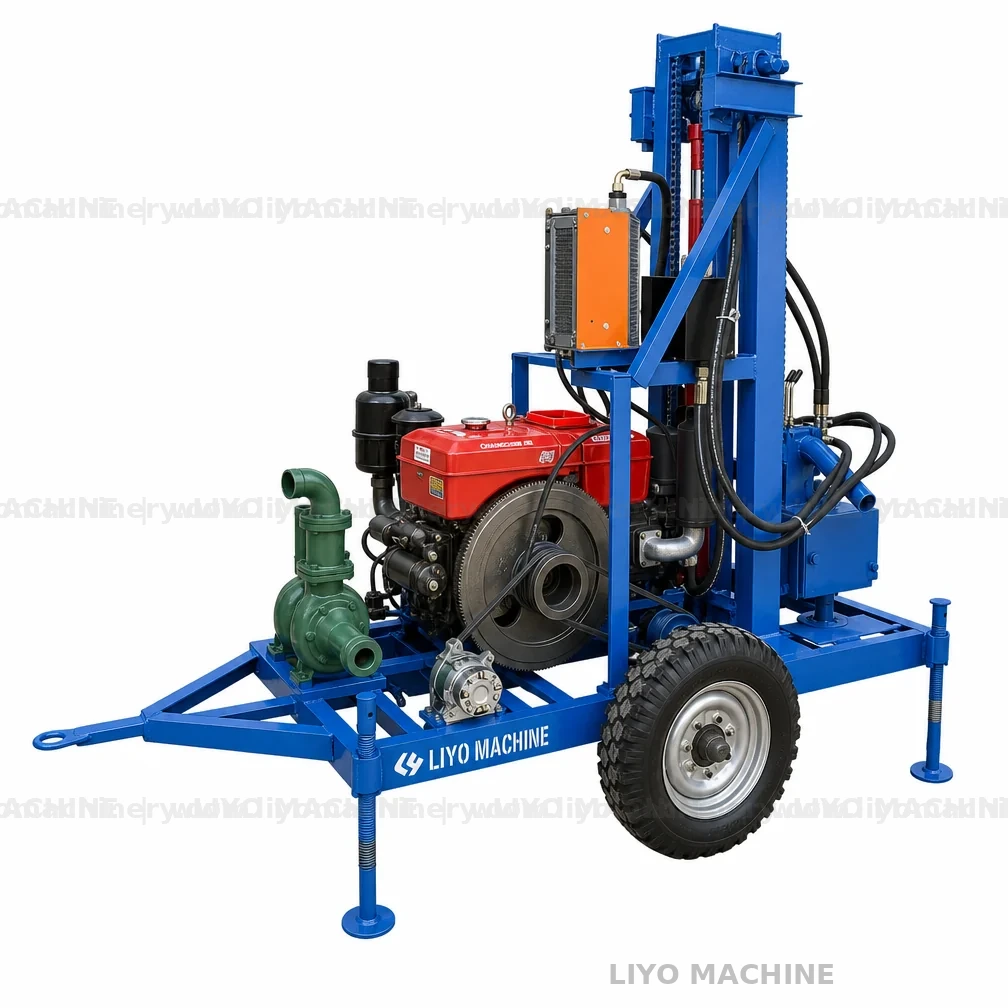
Choose the Well System Before the Machine Package
First-time buyers should confirm the pump, casing, borehole, depth and geology in a clear order.
| Decision | What to Confirm | Why It Matters |
|---|---|---|
| 1. Submersible pump | Pump outside diameter, flow and head | The pump must fit freely inside the finished casing. |
| 2. Well casing | Casing inside and outside diameter | Its inside diameter must be larger than the pump, with installation clearance. |
| 3. Borehole diameter | Bit diameter and finished hole plan | The borehole must be larger than the casing to allow installation, sealing or gravel pack. |
| 4. Drilling depth | Expected water level and target depth | Depth controls rod quantity, working time and power reserve. |
| 5. Ground condition | Clay, sand, gravel, mixed ground or rock | Geology decides the bit and whether mud or DTH tools are suitable. |
Use the Correct Size Order
The practical relationship is: borehole diameter is larger than casing outside diameter, and casing inside diameter is larger than submersible pump outside diameter. The exact clearance depends on casing wall thickness, gravel pack, sealing method, local well practice and the installer recommendation.
Do Not Choose the Bit From Pump Diameter Alone
A pump may fit inside a casing, but the casing still needs enough space in the drilled hole. A first-time buyer should provide the pump model or outside diameter, the planned PVC or steel casing size and the local well construction method before selecting a drill bit.
Depth and Diameter Must Be Considered Together
A deeper hole or a larger diameter increases drilling load. The LY-150 is commonly considered for 100m to 150m projects, but actual performance depends on borehole diameter, formation, drilling method and operator experience. A large hole should not be treated as having the same depth capability as a smaller hole.
Ask the Local Pump Installer Before Ordering
A local pump or well contractor can confirm the pump capacity, casing size and common borehole practice for the area. This small step prevents buying a bit that is too small, a casing that cannot accept the pump or an unnecessarily large drilling package.
Prepare Five Facts for a Reliable Recommendation
Send the target depth, pump diameter or model, casing size, expected ground condition and project country. LIYO can then recommend the LY-150 rod length, bit size, mud-circulation accessories and a practical machine configuration.
Explore the LY-150 Water Well Drilling Machine
Continue the LY-150 Selection Process
Questions From First-Time Buyers
Should the borehole be the same size as the water pump?
No. The pump fits inside the casing, and the casing fits inside the borehole. The borehole therefore needs to be larger than the casing, while the casing inside diameter needs to be larger than the pump outside diameter.
How much larger should the borehole be than the casing?
There is no single clearance for every well. It depends on casing wall thickness, gravel pack, sealing method, geology and local construction practice. Confirm the final size with the local well or pump installer.
Can I choose the LY-150 only by drilling depth?
No. Depth is important, but diameter and geology change the drilling load. A correct recommendation needs depth, borehole diameter and ground condition together.
Is LY-150 suitable for a first-time buyer?
It can be a practical compact wheeled machine for suitable 100m to 150m projects, provided the buyer confirms the well design, drilling method and required accessories before ordering.
Need an LY-150 Package Recommendation?
Send the target depth, pump or casing size, borehole diameter, ground condition and project country. LIYO will recommend a practical configuration without promising an unsuitable machine.